Semi-Autonomous AI Workflows & Template Development
Developing reusable workflow templates that translate human intent into structured AI-assisted research, planning, implementation, testing, and delivery.
Project Overview
This ongoing project explores how AI tools can carry out substantial development work under clearly defined human direction. I define the objective, constraints, and acceptance criteria; AI handles technical execution within the approved scope and presents its results for review.
The work focuses on preparing and refining templates that preserve project context, guide execution, document decisions, and support continuity between conversations and AI tools.
The templates define the project objective, scope, constraints, AI authority, approval points, handoff requirements, and acceptance criteria. They also provide a structure for recording decisions, verification results, and unresolved work, so another conversation or AI tool can continue from a documented project state.
My Role
As the workflow designer and project owner, I establish the intended outcome, evaluate proposed approaches, define authority boundaries, and review the delivered work.
I also examine where the process fails—such as incomplete context, scope drift, unsupported completion claims, or premature closure—and use those findings to improve subsequent templates.
Workflow Structure
Each template organizes the project around a consistent sequence:
- Define the objective: Record the intended result, constraints, scope, and acceptance criteria.
- Research and plan: Examine requirements, compare approaches, and present a proposed direction for approval.
- Prepare the handoff: Provide the implementation tool with the necessary context, decisions, and execution boundaries.
- Implement and verify: Produce the required files, run relevant checks, correct identified problems, and record evidence.
- Review and revise: Present the result for human evaluation and address requested changes.
- Close and preserve: Record acceptance, unresolved items, and the information needed to resume the project.
Routine technical decisions can proceed within the approved scope. Changes affecting the objective or agreed boundaries return to human review.
Template Evolution
The work developed through four successive approaches:
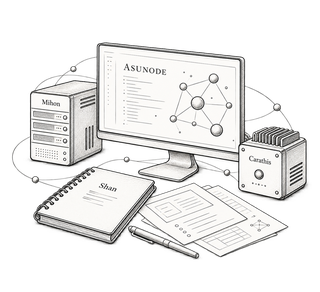
ASUNODE established the initial context-based workflow, connecting project intent, development tasks, version control, and persistent project records.
Shan expanded the structure with explicit authority boundaries, acceptance criteria, verification requirements, and lifecycle records.
Carathis explored a lighter operational approach, reducing the amount of context required at each stage and simplifying the transition from planning to implementation.
Mihon continued this refinement by revisiting revision cycles, user review, and closure conditions. It remains a candidate standard under evaluation.
Application Experience
The workflows were explored through context-preparation experiments, web projects, and desktop applications.
Representative applications include Shan3A, a Flutter contacts application; A17, a personal finance tracking application; and A19, a vehicle maintenance service application. These projects provided practical experience in implementation, testing, review, and documenting deferred issues.
A23, an early-warning application, was prepared as a further evaluation case for Mihon. Its preparation does not yet establish a completed end-to-end workflow.
Project Deliverables
The work has produced successive workflow template versions, handoff documents, context and decision records, acceptance criteria, and verification reports.
These deliverables connect the intended outcome with implementation instructions, review requirements, and recorded results. Closure records preserve completed work, deferred issues, and the information needed for future continuation.
Their maturity varies: some were used in application development, while others remain candidates for further evaluation.
Project Memory and Continuity
Git checkpoints support technical traceability and recovery. Persistent context records capture the objective, decisions, reasons for changes, verification results, and remaining work.
The aim is to make a project understandable and resumable without depending entirely on a single conversation or AI tool.
Current Status
This is an ongoing workflow design and evaluation project. It has produced successive template versions and practical application experience, while also revealing limitations that require further testing.
The central principle is consistent throughout: human intent and acceptance guide the work; AI executes within defined authority and reports results with supporting evidence.